 090003 25483
 Yashoda Hospitals Hitec City Hyderabad, Kothaguda, Telangana 500084

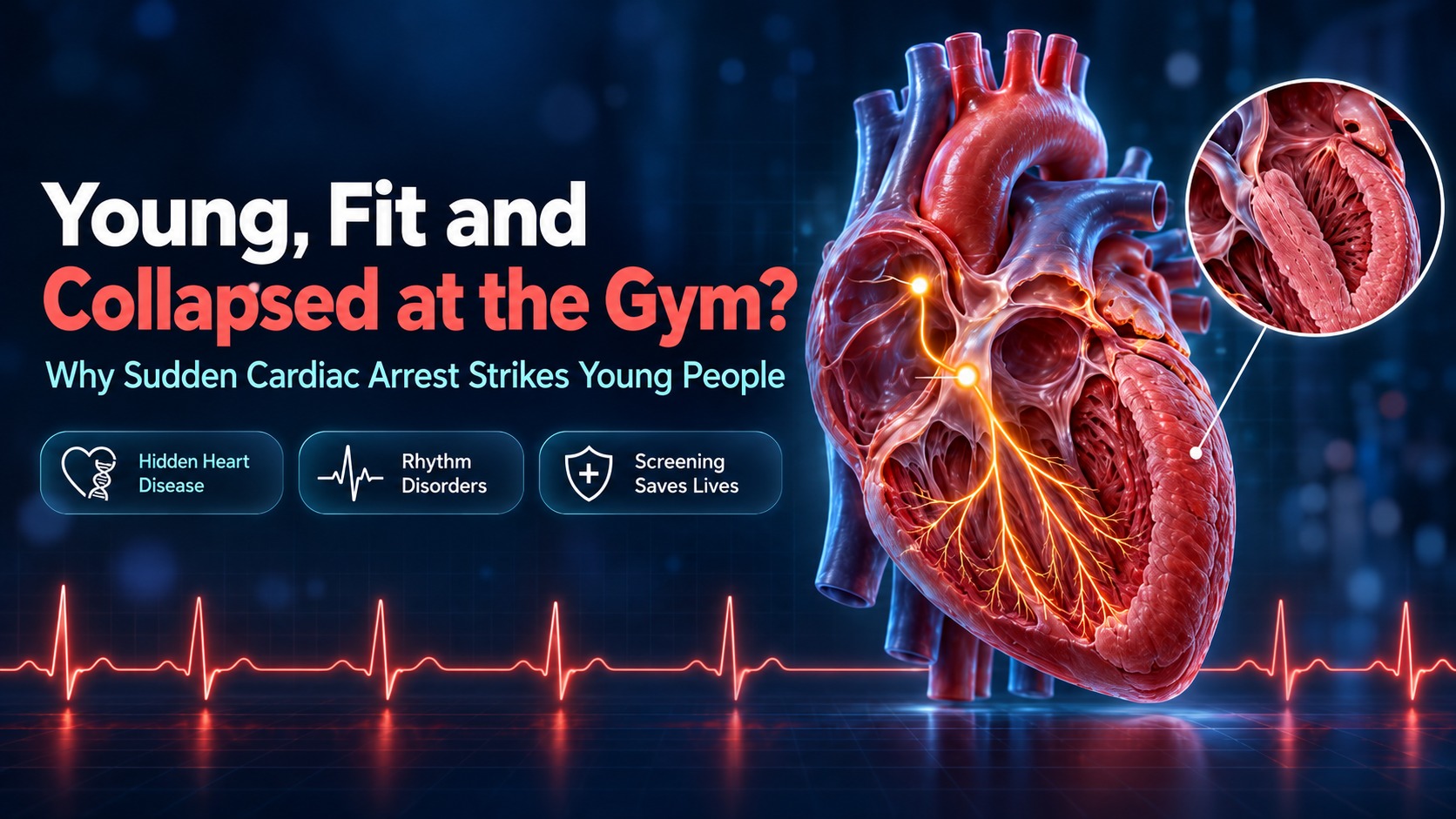
“He was young, fit and never sick. How can someone like that just collapse at the gym?”
MD, DM (Cardiology) · Interventional Cardiologist & Electrophysiologist✔ Medically reviewed⏱ 8 min read
- Heart attack vs cardiac arrest: not the same thing
- The hidden causes in young people
- Warning signs your body gives early
- Should you get screened? A quick self-check
- Tests that find hidden heart problems
- Safer workouts: practical gym rules
- If someone collapses: what to do in the first minute
- Questions people ask
Heart Attack vs Cardiac Arrest: Not the Same Thing
People often use the two terms interchangeably, but they are very different problems.
Heart attack = a plumbing problem
A blood vessel supplying the heart gets blocked. Part of the heart muscle starts to die. The person is usually awake, often with chest pain, sweating or breathlessness.
Cardiac arrest = an electrical problem
The heart’s rhythm suddenly becomes chaotic (ventricular fibrillation), so it quivers instead of pumping. The person collapses within seconds, stops breathing normally and has no pulse.
“A heart attack can trigger a cardiac arrest, but in young people the trigger is very often an electrical or structural heart condition they never knew they had. That is exactly why it feels so sudden.”
The Hidden Causes in Young People
In people under about 35, the most common culprits are conditions that are present from birth or develop silently. In people in their late 30s and 40s, early coronary artery disease becomes increasingly important, especially in India.
Hypertrophic cardiomyopathy (HCM)
The heart muscle becomes abnormally thick. Often inherited. Intense exertion can trigger dangerous rhythms.
Inherited rhythm disorders
Long QT syndrome, Brugada syndrome and CPVT. The heart looks normal on a scan, but its electrical system is faulty. An ECG often gives the first clue.
Extra electrical pathway (WPW)
An extra connection in the heart can, rarely, conduct dangerously fast rhythms. It can usually be cured with catheter ablation.
Myocarditis
Inflammation of the heart muscle, often after a viral infection. Heavy exercise during or soon after a fever is risky.
Early coronary artery disease
Blockages at a young age, driven by smoking, diabetes, high cholesterol, family history or high lipoprotein(a).
Steroids & stimulants
Anabolic steroids, some “fat-burner” and high-stimulant pre-workout products, and recreational drugs can strain the heart and provoke rhythm problems.
Warning Signs Your Body Gives Early
Many young people who collapse had at least one warning sign beforehand that was brushed off as stress, dehydration or “just tiredness”.
🚩 Do not ignore these
- Fainting or near-fainting during or right after exercise. This is the biggest red flag.
- Chest pain or pressure on exertion
- A racing or pounding heartbeat with dizziness
- Breathlessness far out of proportion to effort
- A family member who died suddenly or unexpectedly before 50
- Fainting triggered by a loud alarm, swimming or strong emotion
✅ Usually less worrying (but mention them)
- A brief, single skipped beat at rest
- Feeling light-headed on standing up quickly after lying down
- Fainting at the sight of blood or a needle, with a clear trigger and warning feeling
- Normal breathlessness that settles quickly after hard exercise
Should You Get Screened? A Quick Self-Check
📝 Tick any that apply to you
Tests That Find Hidden Heart Problems
Screening usually starts simple. Further tests are added only if the first ones, or your history, suggest a problem.
| Test | What it looks for | What it involves |
|---|---|---|
| ECG | Long QT, Brugada pattern, WPW, thick heart muscle clues | 5 minutes, painless |
| Echocardiogram | Thickened or weak heart muscle, valve problems | Ultrasound of the heart, about 20 minutes |
| Treadmill (stress) test | Exercise-induced rhythm problems or blockages | Walking on a treadmill with ECG monitoring |
| Holter monitor | Rhythm problems during daily life | Small recorder worn for 24 to 48 hours or longer |
| Cardiac MRI | Scarring, inflammation, cardiomyopathies | Scan of about 45 minutes |
| Blood tests | Cholesterol, lipoprotein(a), sugar | Simple blood sample |
| Genetic testing | Inherited cardiomyopathies and rhythm disorders | Advised selectively, with counselling |
Safer Workouts: Practical Gym Rules
Build up gradually
Increase intensity over weeks, not days. Sudden jumps in training load add stress to the heart.
Never “push through” warning symptoms
Stop immediately if you feel chest pain, dizziness, a racing heart or unusual breathlessness, and get checked.
Skip workouts during fever or a viral illness
And ease back gradually afterwards. Exercising hard with an infection can strain an inflamed heart.
Say no to steroids and high-stimulant products
“Fat-burners” and heavy pre-workouts can provoke rhythm problems in a vulnerable heart.
Know your numbers
BP, sugar, cholesterol and lipoprotein(a), especially if there is a family history.
Ask your gym about its AED
Every gym should have an automated external defibrillator (AED) and staff trained in CPR.
If Someone Collapses: The First Minute Matters
Act immediately. Don’t wait to “see if they wake up”
- Check: tap and shout. Not responding and not breathing normally? Treat it as cardiac arrest.
- Call 108 (or ask someone to) and ask for an AED to be brought.
- Push hard and fast in the centre of the chest: about 100 to 120 compressions per minute, at least 5 cm deep.
- Use the AED as soon as it arrives. It talks you through every step and will only shock if needed.
Hands-only CPR is enough for untrained bystanders. Doing something is far better than doing nothing.
“If you have survived a cardiac arrest or been diagnosed with a high-risk rhythm condition, treatment such as an ICD, medicines or catheter ablation can be life-saving. The first step is an accurate diagnosis.”
Questions People Ask
Is sudden cardiac arrest the same as a heart attack?
Can a normal ECG rule everything out?
Is the gym itself dangerous?
Are protein supplements harmful to the heart?
My friend collapsed at the gym. Should I get tested?
Can these hidden conditions be treated?
📌 Remember these points
- Cardiac arrest is an electrical failure, not the same as a heart attack.
- In young people it is often caused by a hidden heart condition.
- Fainting during exercise is a red flag. Never ignore it.
- Simple tests like an ECG and echo can detect many of these conditions.
- Immediate CPR and an AED save lives. Learn hands-only CPR.
Collapse, fainting or a family history? Get checked.
Dr. V. Rajasekhar evaluates young people with fainting, palpitations, abnormal ECGs or a family history of sudden death, and plans targeted screening and treatment.
Dr. V. Rajasekhar (Dr. Rajasekhar Varada)
Dr. Rajasekhar specialises in heart rhythm disorders (electrophysiology), catheter ablation, ICD and pacemaker therapy, and complex coronary interventions, so both the electrical and the plumbing causes of sudden cardiac arrest are evaluated together.
This article is for general patient education and does not replace a personal medical consultation. Diagnosis and treatment depend on your individual symptoms, test results and overall health. References: American Heart Association guidelines for CPR and emergency cardiovascular care; European Society of Cardiology guidelines on ventricular arrhythmias and prevention of sudden cardiac death; ESC guidelines on sports cardiology.