 090003 25483
 Yashoda Hospitals Hitec City Hyderabad, Kothaguda, Telangana 500084
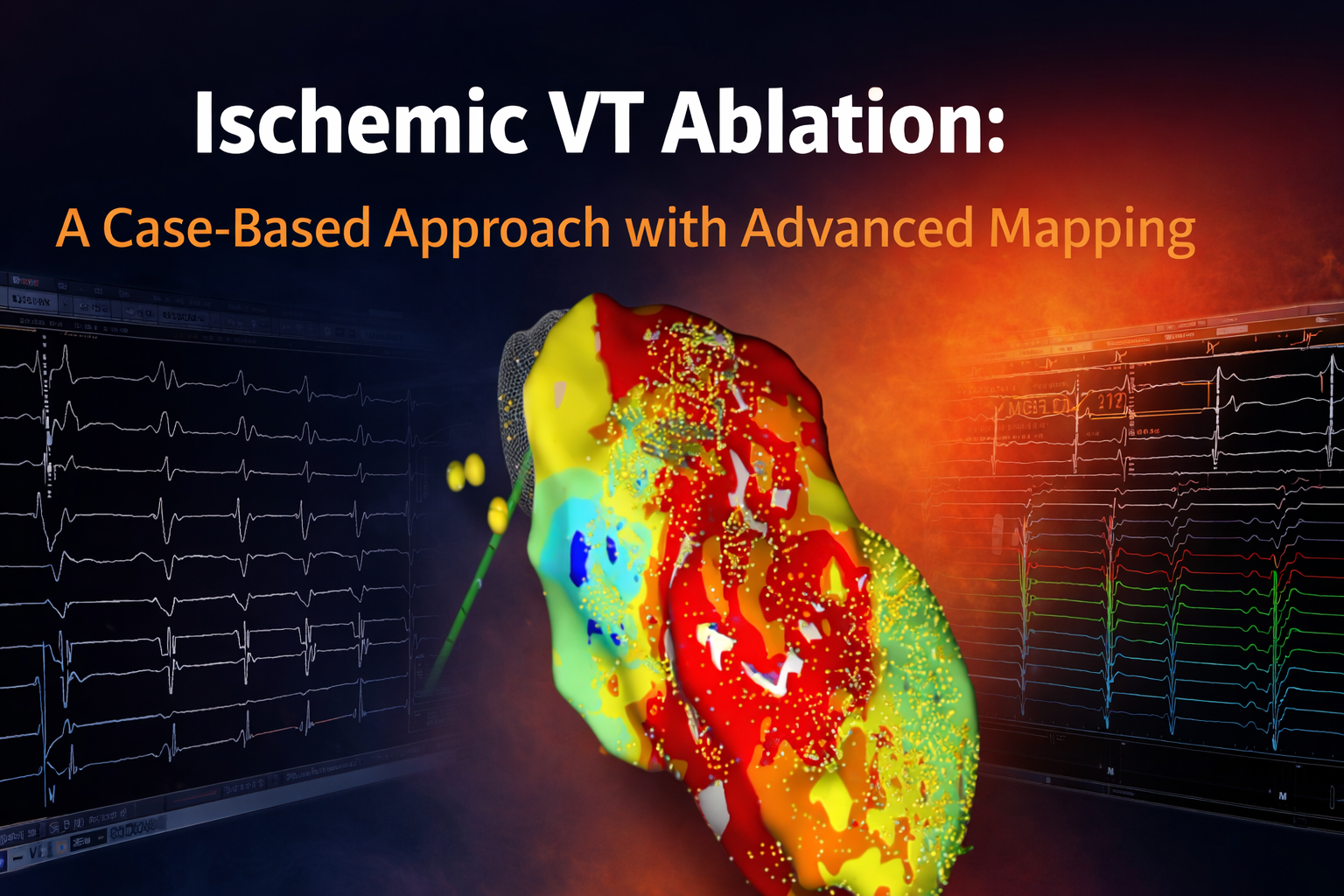
Ischemic Ventricular Tachycardia (VT) remains one of the most challenging and potentially life-threatening arrhythmias encountered in patients with structural heart disease. With advancements in electrophysiology, 3D mapping, and catheter ablation techniques, the management of VT has evolved significantly—offering improved outcomes even in complex cases.
This blog presents a detailed case-based overview of ischemic VT ablation, highlighting the role of deep substrate mapping, LAT (Local Activation Time) mapping, and radiofrequency (RF) ablation in achieving arrhythmia control.
Patient Profile & Clinical Background
A 69-year-old male presented with:
- History of Ischemic Cardiomyopathy (ICMP)
- Prior PTCA to LAD & RCA
- Severe Left Ventricular dysfunction (EF ~30%)
- Implanted CRT-D device
- Recurrent episodes of Ventricular Tachycardia (VT) requiring:
- Anti-tachycardia pacing (ATP)
- ICD shocks
Baseline ECG Findings
- Sinus rhythm
- Left Bundle Branch Block (LBBB) morphology
- Device in monitoring mode (pacing off, defibrillator active)
👉 This clinical picture strongly indicates scar-related re-entrant VT, common in post-infarction patients.
Understanding Ischemic VT
In ischemic heart disease, myocardial scarring creates abnormal electrical circuits. These circuits allow re-entry of electrical impulses, leading to sustained VT.
Key Mechanism:
- Scar tissue → slow conduction pathways → re-entry circuits → VT
Electrophysiology Study & VT Induction
During the EP study:
- VT was successfully induced using programmed stimulation
- The rhythm was hemodynamically unstable, limiting prolonged mapping
👉 This necessitated a substrate-based mapping approach rather than conventional activation mapping.
Deep Mapping & 3D Electroanatomical Mapping
1. Substrate Mapping
A detailed electroanatomical map of the left ventricle was created.
- Scar areas identified (low voltage zones)
- Border zones marked for potential VT circuits
2. LAT (Local Activation Time) Mapping
- Helped identify delayed conduction pathways
- Highlighted critical isthmus regions within the scar
3. Findings
- Extensive scar involving left ventricular myocardium
- Multiple channels within scar acting as VT circuits
👉 These channels are the primary targets for ablation
VT Morphology Analysis
The induced VT showed:
- Wide complex tachycardia
- Consistent morphology suggesting a re-entrant circuit
- Correlation with mapped scar regions
👉 Morphology helps in localizing origin and guiding ablation strategy
Hemodynamically Unstable VT: Strategy Shift
Because VT was unstable:
- Continuous mapping during VT was not feasible
- Shifted to:
- Substrate-based ablation
- Pace mapping
- Identification of late potentials (MDP – Mid-Diastolic Potentials)
Identification of Critical Circuits (MDP Mapping)
What are MDPs?
- Signals recorded during VT
- Represent critical parts of re-entry circuit
Mapping Outcome:
- MDPs identified in both:
- 2D electrograms
- 3D mapping system
👉 These are high-value ablation targets
Radiofrequency (RF) Ablation Strategy
Approach:
- Target scar border zones
- Eliminate:
- Late potentials
- Fractionated signals
- MDP sites
Lesion Delivery:
- RF energy applied systematically
- Creation of linear lesions across channels
Post-Ablation Assessment
After RF ablation:
- Attempted re-induction of VT
- No sustained VT could be induced
👉 This indicates successful substrate modification
Clinical Outcome & Significance
Benefits of VT Ablation:
- Reduction in ICD shocks
- Improved quality of life
- Decreased arrhythmia burden
- Potential survival benefit in select patients
Why Advanced Mapping is Critical
Modern VT ablation relies heavily on:
- 3D electroanatomical mapping systems
- High-resolution signal analysis
- Identification of:
- Scar tissue
- Conduction channels
- Critical isthmus
👉 Without these, success rates are significantly lower in complex VT.
Key Takeaways
- Ischemic VT is primarily scar-mediated
- Hemodynamically unstable VT requires substrate-based approach
- MDP and LAT mapping are crucial for precision
- RF ablation can effectively eliminate VT circuits
- Advanced EP techniques significantly improve outcomes
This case highlights the importance of a comprehensive electrophysiological strategy in managing complex ischemic VT. With the integration of deep mapping techniques and targeted RF ablation, even high-risk patients with severe LV dysfunction can achieve excellent arrhythmia control.
About the Expert
Dr. V. Rajsekhar
Senior Consultant – Interventional Cardiology & Electrophysiology
Certified Proctor for TAVR & Clinical Director
Ischemic VT ablation | Ventricular tachycardia treatment India | VT ablation procedure | Scar-related VT mapping | Electrophysiology study VT | RF ablation for ventricular tachycardia | Advanced cardiac ablation techniques