 090003 25483
 Yashoda Hospitals Hitec City Hyderabad, Kothaguda, Telangana 500084
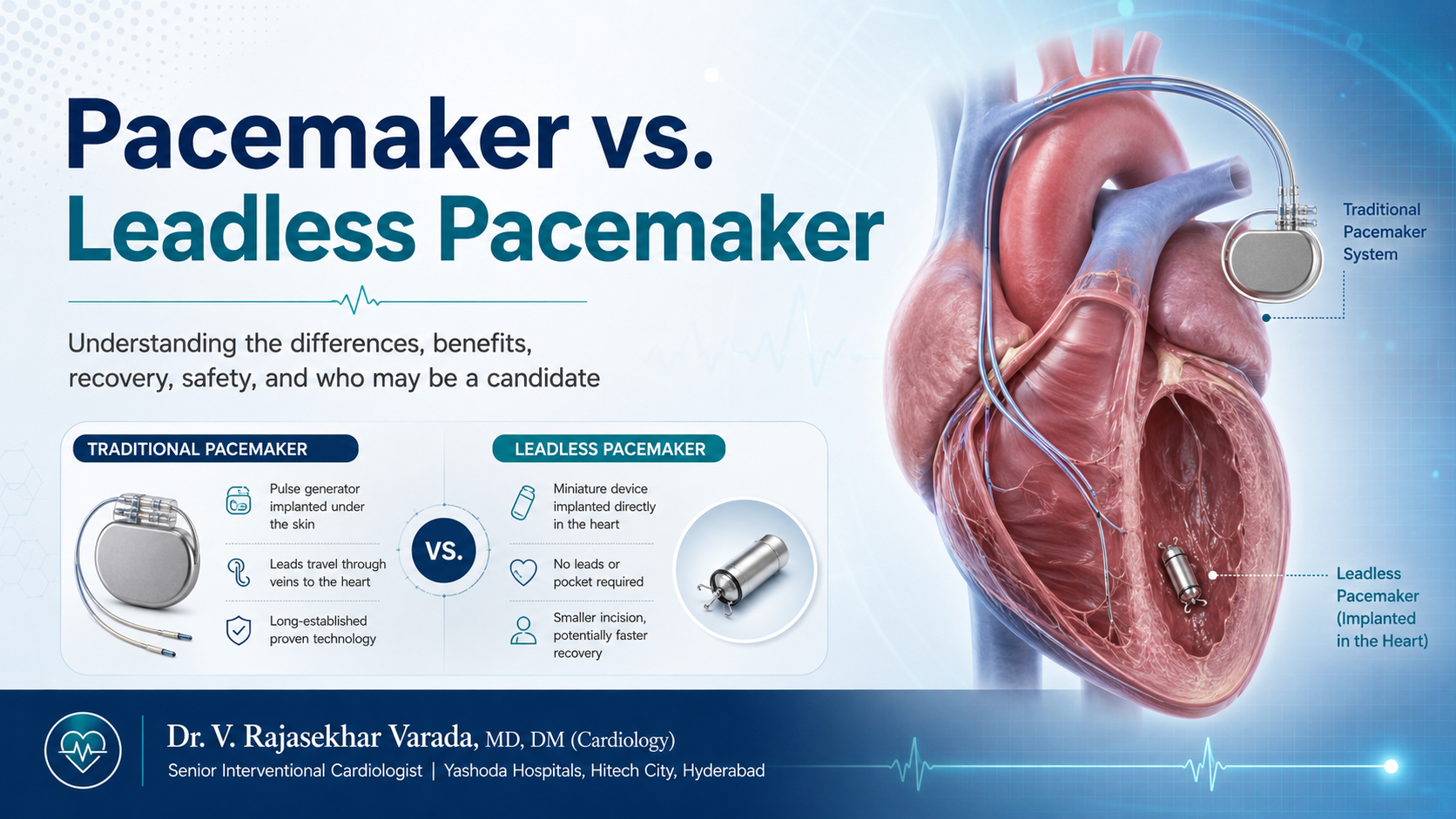
A pacemaker may be recommended when the heart beats too slowly, pauses unexpectedly, or fails to conduct electrical signals normally between its upper and lower chambers.
For many years, the standard treatment has been a traditional pacemaker placed beneath the skin of the chest and connected to the heart through one or more thin wires called leads.
Today, some patients may also be treated with a leadless pacemaker—a much smaller device implanted directly inside the heart without a chest incision, surgical pocket, or conventional pacing leads.
But does “leadless” automatically mean better or safer? Who is actually eligible? What happens when the battery runs out? Can you undergo an MRI? And how different is the recovery?
The answer depends on your heart rhythm problem, the number of chambers that need pacing, your age, infection risk, vein anatomy, heart function and future treatment requirements.
Quick Answer: Traditional Pacemaker vs. Leadless Pacemaker
| Feature | Traditional pacemaker | Leadless pacemaker |
|---|---|---|
| Device position | Under the skin below the collarbone | Directly inside the heart |
| Wires or leads | One, two or three leads may be used | No conventional leads |
| Implant access | Vein near the collarbone | Femoral vein in the groin |
| Chest incision | Yes | No |
| Chest scar or bump | Usually present | Usually absent |
| Pocket infection risk | Present | No chest pocket |
| Lead fracture or failure | Possible over time | No conventional lead |
| Pneumothorax risk | Possible during chest-vein access | Generally avoided |
| Main procedure-specific risks | Pocket bleeding, infection, lead movement, lung injury | Groin bleeding, vascular injury, cardiac perforation or device movement |
| Single-chamber pacing | Available | Available |
| Dual-chamber pacing | Widely available | Available with selected newer systems |
| CRT for heart failure | Available | Usually requires another pacing strategy |
| Recovery restrictions | Chest wound and temporary arm restrictions | Mainly groin-care restrictions |
| Battery management | Generator is replaced through the existing chest pocket | Device may be turned off and another implanted, or retrieved in selected cases |
| MRI | Possible with an MRI-conditional system and protocol | Possible with an MRI-conditional system and protocol |
The European Society of Cardiology recommends considering leadless pacing particularly when there is no suitable upper-body venous access, when infection risk is high, or when a conventional device pocket and leads would create important problems. Device selection should still be based on the individual patient’s pacing requirements and shared decision-making.
What Does a Pacemaker Do?
The heart has its own electrical system. It produces electrical impulses that tell the chambers when to contract and pump blood.
If these impulses become too slow, irregular or blocked, a person may experience:
- Dizziness or light-headedness
- Unexplained tiredness
- Fainting or near-fainting
- Shortness of breath
- Reduced exercise capacity
- Confusion, particularly in older adults
- Pauses in the heartbeat
- A persistently slow pulse
A pacemaker monitors the heartbeat and delivers a small electrical impulse when the heart rate falls below the programmed limit.
A pacemaker does not continuously “shock” the heart. It usually remains in the background and provides pacing only when required.
What Is a Traditional Pacemaker?
A traditional pacemaker has two main components:
- A pulse generator containing the battery and electronic circuitry
- One or more insulated wires, known as leads, that connect the generator to the heart
The pulse generator is generally placed beneath the skin, usually below the collarbone. The leads are passed through a vein and positioned inside the appropriate heart chamber or chambers under X-ray guidance.
Depending on the condition, a patient may receive:
Single-chamber pacemaker
One lead usually delivers pacing to the right ventricle, although selected systems may pace the right atrium.
Dual-chamber pacemaker
Two leads are generally used—one in the right atrium and one in the right ventricle. This allows the pacemaker to coordinate the upper and lower chambers.
Cardiac resynchronisation therapy pacemaker
A CRT pacemaker is designed for selected patients with heart failure and electrical dyssynchrony. It usually uses additional pacing to help the ventricles contract in a more coordinated manner.
Traditional pacemakers remain the most versatile option because they can provide single-chamber, dual-chamber and resynchronisation therapy.
What Is a Leadless Pacemaker?
A leadless pacemaker is a compact pacemaker in which the battery, electronic components and pacing electrode are contained within one small unit.
Instead of being placed beneath the skin of the chest, the device is delivered through a catheter inserted into the femoral vein in the groin. It is advanced into the heart and attached directly to the inner wall of the appropriate chamber.
Because the pacemaker is located inside the heart:
- There is no chest generator pocket
- There are no conventional pacing wires running through the veins
- There is usually no visible chest scar
- There is no pacemaker bump beneath the skin
- Arm movement restrictions are generally less extensive
Leadless pacemakers were initially designed mainly for single-chamber ventricular pacing. However, technology has progressed.
Some ventricular leadless pacemakers can sense mechanical activity from the atrium and coordinate ventricular pacing with it, but they do not directly pace the atrium. More recently, true dual-chamber leadless systems using separate atrial and ventricular devices have become available.
A true dual-chamber leadless system was launched in India in October 2025. It uses one device in the right atrium and another in the right ventricle, allowing the two devices to communicate and coordinate pacing without conventional leads.
Availability, suitability and operator experience can differ between hospitals, regions and device platforms.
Am I a Candidate for a Leadless Pacemaker?
You may be considered for a leadless pacemaker when your required pacing pattern can be delivered effectively by the available leadless system.
Potential candidates may include patients with:
1. Permanent atrial fibrillation with a slow ventricular rate
When the atria are already in permanent atrial fibrillation, coordinated atrial pacing may not be necessary. Ventricular-only leadless pacing may therefore be suitable for some patients.
2. Intermittent or persistent atrioventricular block
Selected patients with AV block may benefit from a leadless system capable of maintaining an appropriate relationship between atrial activity and ventricular pacing.
The exact suitability depends on whether the patient needs atrial pacing, how reliably atrial activity can be detected, activity level and the underlying rhythm.
3. Sinus node dysfunction
Some patients with sinus node dysfunction may be eligible for a true dual-chamber leadless system. Others may still be better treated with a conventional dual-chamber pacemaker.
4. Previous pacemaker infection
Patients who have experienced a device-pocket infection or lead-related infection may benefit from avoiding a new chest pocket and transvenous leads.
5. High infection risk
Leadless pacing may be considered in selected patients with:
- Previous cardiac-device infection
- Haemodialysis
- Poor wound healing
- Recurrent bloodstream infections
- Immunosuppression
- Limited suitable venous access
6. Blocked or unsuitable veins
A conventional pacemaker requires access to a suitable vein in the upper chest. A leadless system may offer an alternative when those veins are blocked, narrowed, previously used or otherwise unsuitable.
7. Cosmetic or occupational concerns
The absence of a chest scar and visible generator may be important to some patients, particularly younger individuals, women, athletes, performers or people whose work involves pressure from straps or protective equipment over the upper chest.
Cosmetic preference alone, however, should not override the need to choose the pacing system that provides the most appropriate long-term therapy.
Who May Not Be Suitable for a Leadless Pacemaker?
A leadless pacemaker is not automatically the best choice for every person.
A conventional or alternative pacing system may still be preferable when the patient needs:
Cardiac resynchronisation therapy
Patients with reduced heart-pumping function and significant electrical dyssynchrony may require CRT or another specialised pacing approach. A standard ventricular leadless pacemaker does not provide conventional biventricular CRT.
Defibrillation protection
A pacemaker treats slow heart rhythms. It does not necessarily treat dangerous rapid ventricular rhythms.
A patient at risk of ventricular tachycardia or ventricular fibrillation may need an implantable cardioverter-defibrillator rather than a pacemaker alone.
Complex multi-chamber pacing
Although true dual-chamber leadless pacing now exists, conventional devices may remain more suitable for some patients with complex pacing, sensing or programming needs.
Certain anatomical conditions
Unusual heart anatomy, mechanical heart valves, intracardiac masses, blood clots, congenital heart disease or insufficient space for safe device positioning may affect eligibility.
Anticipated need for future system upgrades
A younger patient’s pacing requirements may change over several decades. The possibility of future CRT, defibrillator therapy, conduction-system pacing or multiple device replacements must be considered before selecting a system.
The decision should therefore be based on a long-term treatment plan—not only on which procedure appears simpler today.
How Is a Traditional Pacemaker Implanted?
A conventional pacemaker implantation commonly follows these steps:
Step 1: Preparation
The chest is cleaned, monitoring equipment is attached and an intravenous line is placed. Antibiotics may be given to reduce infection risk.
Step 2: Anaesthesia and sedation
The skin beneath the collarbone is numbed using local anaesthesia. Light sedation may be given to help the patient remain comfortable.
Step 3: Creating the pocket
A small incision is made below the collarbone, and a pocket is created under the skin or muscle for the generator.
Step 4: Placing the leads
One or more leads are guided through a nearby vein into the heart using fluoroscopy, a form of real-time X-ray imaging.
Step 5: Testing
The cardiologist tests each lead to confirm that it senses the heartbeat properly and can pace the heart using an acceptable amount of energy.
Step 6: Connecting the generator
The leads are connected to the pacemaker generator, which is positioned in the chest pocket.
Step 7: Closing the incision
The wound is closed and dressed. The pacemaker is programmed according to the patient’s rhythm requirements.
How Is a Leadless Pacemaker Implanted?
A leadless pacemaker implantation usually involves the following steps:
Step 1: Groin preparation
The skin over the groin is cleaned and numbed. Sedation or anaesthesia is provided according to the patient’s health and the procedure plan.
Step 2: Femoral vein access
The cardiologist inserts a sheath into the femoral vein.
Step 3: Catheter delivery
A specialised delivery catheter containing the pacemaker is advanced through the vein into the right side of the heart.
Step 4: Finding the appropriate position
The cardiologist identifies an appropriate implant site and may test electrical measurements before final release.
Step 5: Device fixation
The device is attached to the inner heart wall using small tines or a fixation mechanism, depending on the device design.
Step 6: Electrical testing
The pacing threshold, sensing and electrical resistance are checked.
Step 7: Device release
Once the position and measurements are satisfactory, the device is released from the catheter.
Step 8: Catheter removal
The catheter and sheath are removed, and pressure or a closure technique is used at the groin access site.
With a dual-chamber leadless system, separate devices are implanted in the right atrium and right ventricle and then paired to provide coordinated pacing.
Is a Leadless Pacemaker Safer?
Leadless pacemakers eliminate several important components that can cause complications in traditional systems: the chest pocket, transvenous leads and upper-chest venous access.
This can reduce or avoid:
- Pocket infection
- Pocket erosion
- Pocket haematoma
- Visible device movement
- Lead fracture
- Lead insulation failure
- Lead dislodgement
- Venous obstruction related to leads
- Pneumothorax caused during upper-chest venous access
However, leadless pacemakers have their own procedural risks, including:
- Bleeding or haematoma at the groin
- Femoral-vein injury
- Cardiac perforation
- Pericardial effusion
- Cardiac tamponade
- Device movement or embolisation
- Difficulty obtaining a stable implant position
- Injury to a heart valve
- Need for urgent intervention in rare cases
In a five-year post-approval registry of 1,809 patients with a single-chamber Micra leadless pacemaker, the major complication rate was 4.1% at three years and 4.5% at five years. At three years, the matched transvenous comparison group had a major complication rate of 8.5%. System revisions were also lower in the leadless group. However, the comparison was not a randomised trial and related to a particular single-chamber system, so the numbers should not be applied to every patient or every leadless device.
The practical answer is:
Leadless pacing may reduce lead- and pocket-related complications, but it introduces different catheter- and heart-related risks.
Safety depends heavily on correct patient selection, operator experience, heart anatomy and the pacing system being implanted.
How Long Does a Leadless Pacemaker Last?
Battery life is not identical for every device or patient.
It depends on:
- How frequently pacing is required
- The amount of energy needed with each impulse
- The programmed heart rate
- Pacing mode
- Electrical measurements at the implant site
- Whether multiple devices must communicate
- Device model and generation
Traditional pacemaker generators commonly last approximately 5–15 years, although an individual device may last longer or shorter.
Projected longevity for newer leadless pacemaker models can extend into the mid-teens. For example, one current ventricular leadless model lists a projected longevity of 16.7 years, while an atrioventricular-synchronous model lists approximately 15.6 years under specified assumptions. These are projections rather than guarantees for an individual patient.
Regular pacemaker checks estimate the remaining battery life well before the device reaches the end of service.
A pacemaker battery does not normally stop without warning. The device provides indicators that allow the heart team to plan replacement in advance.
What Happens When a Leadless Pacemaker Battery Runs Out?
The battery is sealed inside the pacemaker. Therefore, doctors do not replace only the battery—they manage or replace the entire device.
Depending on the device, implant duration, patient anatomy and future pacing requirements, the cardiologist may consider one of several approaches:
Option 1: Turn off the old device and implant another leadless pacemaker
With some leadless devices, the depleted pacemaker may be programmed off and left inside the heart. A new device is then implanted at another suitable location.
This is a commonly considered strategy because removing a device that has been inside the heart for many years may be more difficult than retrieving it soon after implantation.
Option 2: Retrieve the old device
Certain leadless pacemaker systems are designed with retrieval in mind. Retrieval may be considered when technically feasible and clinically appropriate.
Nevertheless, “retrievable” does not mean that every chronically implanted device must or can always be removed without risk. Tissue may develop around the device over time, and the decision requires careful assessment.
Option 3: Implant a traditional system
If the patient’s rhythm condition has changed, a conventional dual-chamber pacemaker, CRT device or defibrillator may be more suitable at the time of replacement.
Option 4: Upgrade the leadless system
In selected platforms, a single-chamber system may potentially be expanded to provide dual-chamber leadless pacing when the patient’s needs evolve.
Battery planning is therefore part of the original pacemaker discussion, particularly for younger patients who may require several device replacements during their lifetime.
Recovery After Pacemaker Implantation
Recovery instructions differ between conventional and leadless implantation.
Recovery after a traditional pacemaker
Patients must allow both the incision and the lead entry sites to heal.
Common instructions may include:
- Keep the wound clean and follow dressing instructions
- Avoid heavy lifting, pushing or pulling during the early recovery period
- Avoid pressure over the pacemaker pocket
- Avoid lifting the implant-side arm above shoulder level for a specified period
- Gradually increase walking and normal activity
- Watch for redness, swelling, discharge, fever or increasing pain
The American Heart Association advises avoiding heavy lifting, pushing, pulling and twisting during the early weeks and avoiding raising the arm on the implant side above the shoulder until the treating team says it is safe.
Patients should not completely immobilise the shoulder for a prolonged period unless instructed, because excessive restriction may contribute to stiffness. The exact movement plan should be obtained from the implanting team.
Recovery after a leadless pacemaker
There is no chest incision or generator pocket. Recovery is therefore mainly focused on the groin puncture site.
Patients may be instructed to:
- Keep the groin site clean and dry as advised
- Avoid strenuous exercise for several days
- Avoid heavy lifting until the access site has healed
- Watch for groin swelling, persistent bleeding or increasing pain
- Report new chest discomfort, severe breathlessness, dizziness or fainting
- Avoid driving until medically cleared
Because there are no chest leads or pocket, prolonged arm restrictions are generally not required after an uncomplicated leadless implant.
When Can I Shower?
After a traditional pacemaker, showering depends on the wound closure, dressing type and the implanting team’s protocol. Some patients may be allowed to shower after several days, while others are asked to keep the incision dry for longer.
The American Heart Association notes that many patients can bathe or shower after approximately four or five days, but the individual hospital’s wound-care instructions should take priority.
Following a leadless pacemaker implant, there is no chest wound. However, the groin site must still be protected until it has sealed appropriately.
Do not soak the implant or access site in a bathtub, swimming pool or hot tub until the cardiology team confirms that healing is complete.
When Can I Drive?
Driving advice depends on:
- Why the pacemaker was needed
- Whether the patient had fainting or loss of consciousness
- Whether the implant was uncomplicated
- Pacemaker dependency
- Private versus commercial driving
- Local licensing regulations
Many centres recommend temporarily avoiding driving after implantation, even when the patient feels well.
A person who received a pacemaker after fainting may face a longer restriction than someone who received an elective pacemaker without loss of consciousness.
Always obtain specific written clearance from the treating cardiologist rather than relying on a general online timeline.
Will There Be a Scar or Bump on My Chest?
Traditional pacemaker
A conventional pacemaker normally creates a small scar below the collarbone. Because the generator sits beneath the skin or muscle, a bump or outline may be visible or palpable.
Visibility depends on:
- Body build
- Amount of tissue over the device
- Device size
- Implant depth
- Scar formation
- Whether the generator is placed beneath the muscle
Thin individuals may notice the generator more clearly.
Women may experience irritation from a bra strap if it passes directly over the incision or device. Implant position can sometimes be planned to reduce discomfort, although safety and access remain the priority.
Leadless pacemaker
A leadless pacemaker does not create a chest incision or chest bump.
There may be a small puncture mark or temporary bruising in the groin, but it generally does not create a permanently visible chest scar.
This may be an important advantage for patients concerned about appearance, clothing, sport or discomfort over the upper chest.
Can I Get an MRI With a Pacemaker?
Many modern traditional and leadless pacemakers are MRI-conditional.
MRI-conditional does not mean that a patient can simply enter any MRI scanner without preparation. It means MRI may be performed when specific conditions are met.
Before an MRI, the hospital may need to:
- Identify the exact pacemaker and lead models
- Confirm that the complete system is MRI-conditional
- Check for abandoned, damaged or incompatible leads
- Assess pacemaker dependency
- Check battery status and device function
- Program the pacemaker into the appropriate MRI mode
- Monitor the patient during the scan
- Restore and recheck the device after scanning
Current leadless models may permit MRI at up to 3 Tesla when all manufacturer conditions are followed.
Some patients with older or non-MRI-conditional systems may still undergo MRI at experienced centres after an individual risk assessment and specialised protocol. The imaging centre and cardiology device team must coordinate the scan.
Always carry your pacemaker identification card and inform the radiology team before scheduling an MRI.
Cost and Insurance: Is a Leadless Pacemaker Worth It?
Leadless pacemakers usually involve a higher upfront device cost than many conventional pacemaker systems.
The final cost may depend on:
- Single-chamber versus dual-chamber therapy
- Pacemaker model
- Hospital and catheterisation laboratory charges
- Anaesthesia requirements
- Length of hospital stay
- Medical complexity
- Insurance network
- Device-related limits in the policy
- Co-payment and deductible clauses
- Pre-authorisation requirements
The most expensive device is not automatically the best device.
A leadless pacemaker may provide meaningful value when avoiding a chest pocket or pacing lead is particularly important—for example, in a patient with previous device infection, poor venous access or a high likelihood of lead-related problems.
A conventional pacemaker may offer better value when the patient requires a proven dual-chamber system, CRT, conduction-system pacing or easier future generator changes.
Before admission, patients should request:
- A written itemised estimate
- The exact pacemaker model
- A description of why that system is recommended
- Expected hospital stay
- Information about consumables and professional fees
- Written insurance pre-authorisation
- Details of device-related sublimits or exclusions
- Expected cost of future follow-up and replacement
The decision should be based on clinical suitability, lifetime treatment strategy and affordability—not marketing claims alone.
Living With a Pacemaker: Common EMI Myths
Modern pacemakers are designed to resist interference from most everyday electronics. Nevertheless, strong magnets and high-powered electrical equipment can temporarily affect device behaviour.
Mobile phones
Mobile phones are generally safe, but the American Heart Association advises keeping the phone at least 15 centimetres or six inches away from an implanted chest device.
Use the ear opposite the traditional pacemaker and avoid carrying a phone in a shirt pocket directly over the device.
Because a leadless pacemaker is located inside the heart rather than beneath the chest skin, the geometry is different, but patients should still follow the device manufacturer’s instructions.
Microwave ovens
Modern microwave ovens are generally considered safe for patients with pacemakers when the appliance is functioning properly.
Induction cooktops
Induction cooktops generate magnetic fields. Patients should avoid leaning directly over an active induction zone and should follow the separation distance recommended by the pacemaker manufacturer.
A person who is highly pacemaker-dependent should discuss frequent induction-cooktop use with the device clinic.
Airport security
Airport metal detectors do not normally damage pacemakers, although the pacemaker may trigger an alarm.
Tell security personnel that you have an implanted cardiac device, carry your pacemaker identification card and avoid remaining close to the detector longer than necessary.
Headphones and magnetic accessories
Headphones, wireless charging accessories, magnetic phone cases and some smart-device accessories may contain magnets.
Do not rest magnetic accessories directly over a traditional chest pacemaker. The American Heart Association advises keeping magnets and magnetic headphones at least six inches away from an implanted device.
Welding equipment
Arc welding and high-powered industrial electrical equipment can create strong electromagnetic fields.
The American Heart Association advises maintaining distance from welding equipment, while Mayo Clinic recommends remaining at least approximately two feet away from welding equipment, high-voltage transformers and motor-generator systems. Patients who weld professionally require an individual workplace assessment.
Household electronics
Most normal household and office equipment poses little or no risk, including:
- Computers
- Wi-Fi routers
- Televisions
- Remote controls
- Electric shavers
- Hair dryers
- Toasters
- Mixers
- Microwave ovens
- Printers
- Scanners
- Electric blankets
Normal use is generally acceptable, but avoid placing devices with strong motors or magnets directly over a traditional pacemaker.
How Do I Know My Pacemaker Is Working?
You may not physically feel the pacemaker delivering each impulse.
Improvement may be noticed through:
- Less dizziness
- Fewer fainting episodes
- Better exercise tolerance
- Reduced fatigue
- Improved alertness
- A more stable heart rate
The most reliable method is pacemaker interrogation.
During an interrogation, the device clinic can review:
- Battery status
- Estimated remaining longevity
- Percentage of time the heart is being paced
- Heart-rate trends
- Sensing performance
- Pacing thresholds
- Lead function in a traditional system
- Recorded high-rate or abnormal rhythm episodes
- Device alerts
- Changes that may require reprogramming
Remote pacemaker monitoring
Many modern pacemakers can transmit information to the treating clinic through a home monitor or compatible mobile technology.
Remote monitoring can help the team detect:
- Battery changes
- Abnormal electrical measurements
- Lead problems
- Device alerts
- Selected arrhythmias
- Changes in pacing requirements
Most current pacemakers can be checked remotely, reducing the need for every routine check to be performed in person.
Remote monitoring is not the same as continuous emergency observation. A patient with chest pain, fainting, severe breathlessness or stroke symptoms should seek urgent medical care rather than waiting for a remote transmission to be reviewed.
Pacemaker vs. ICD vs. Leadless Pacemaker
These devices are frequently confused, but they perform different jobs.
| Device | Primary purpose | Treats slow rhythm? | Treats dangerous fast rhythm? | Typical position |
|---|---|---|---|---|
| Traditional pacemaker | Prevents the heart from beating too slowly | Yes | No | Generator in chest with leads |
| Leadless pacemaker | Prevents selected slow rhythms without conventional leads | Yes | No | Directly inside the heart |
| ICD | Detects and treats dangerous ventricular rhythms | Often includes pacing | Yes | Usually chest generator with lead |
| CRT pacemaker | Coordinates ventricular contraction in selected heart-failure patients | Yes | No | Chest device with multiple leads |
| CRT defibrillator | Provides resynchronisation plus defibrillation | Yes | Yes | Chest device with multiple leads |
An ICD can provide pacemaker functions, but an ordinary pacemaker cannot deliver a lifesaving defibrillation shock.
A leadless pacemaker is therefore not a substitute for an ICD when a patient is at significant risk of sudden cardiac arrest.
Which Pacemaker Is Better?
There is no single winner for every patient.
A leadless pacemaker may be preferable when:
- The required pacing therapy can be delivered by the available leadless system
- Avoiding a chest pocket is important
- Previous device infection has occurred
- Infection risk is unusually high
- Upper-body venous access is limited
- Lead complications are a major concern
- Faster recovery without prolonged arm restrictions is valuable
- A chest scar or bump is a significant concern
A traditional pacemaker may be preferable when:
- A reliable conventional dual-chamber system is required
- CRT is required
- Conduction-system pacing is planned
- Future upgrades are likely
- There is a need for broader programming flexibility
- Groin access is unsuitable
- Heart anatomy makes leadless implantation difficult
- Long-term generator replacement through an existing pocket is preferred
- Cost or insurance coverage is a major limitation
The right question is not simply:
“Is leadless technology newer?”
The more important question is:
“Which pacing system will safely provide the type of therapy I need today and remain appropriate as my heart condition changes?”
Questions to Ask Before Choosing a Pacemaker
Before consenting to implantation, ask your cardiologist:
- What rhythm problem do I have?
- Why do I need a pacemaker?
- Do I need pacing in one chamber or two?
- Do I need atrial pacing?
- Do I need CRT or a defibrillator?
- Am I a suitable candidate for a leadless pacemaker?
- Which leadless system is being considered?
- Is it single-chamber, atrioventricular-synchronous or true dual-chamber?
- What are the benefits of leadless pacing in my specific case?
- What are my individual risks of perforation, bleeding and infection?
- How experienced is the implanting team with this device?
- What battery life is expected with my programmed settings?
- What is the plan when the battery becomes depleted?
- Can the device be retrieved if necessary?
- Can I undergo MRI scans?
- Will remote monitoring be available?
- What will the total cost be?
- What does my insurance policy cover?
- What future upgrades might I require?
- Why is this system preferable to the alternatives?
Frequently Asked Questions
Is leadless pacemaker surgery open-heart surgery?
No. The device is usually delivered through a catheter placed in the femoral vein in the groin. The chest is not opened.
Does a leadless pacemaker have wires?
It does not have conventional pacing leads extending from a chest generator to the heart. The pacing electrode and battery are incorporated into the device implanted inside the heart.
Can a leadless pacemaker support two chambers?
Yes, selected newer systems provide true dual-chamber leadless pacing using separate atrial and ventricular devices. Other leadless systems are ventricular devices that sense atrial mechanical activity but do not directly pace the atrium.
Is a leadless pacemaker invisible?
There is generally no chest scar or generator bump. A small groin puncture mark may be present temporarily.
Can a leadless pacemaker move?
Device movement or embolisation is possible but uncommon. The cardiologist performs fixation and electrical testing before completing the procedure.
Can I exercise after receiving a pacemaker?
Most patients can gradually return to exercise after healing. The timing depends on the implant type, underlying rhythm problem, heart function and the activity involved.
Contact sports that involve direct impact over a traditional chest pacemaker may require additional precautions.
Will I feel the pacemaker pacing my heart?
Most patients do not feel routine pacing. New persistent palpitations, chest discomfort, hiccups, twitching, dizziness or fainting should be reported.
Can I sleep on the pacemaker side?
After a traditional implant, pressure over the wound may be uncomfortable during early healing. Once the incision has healed, many patients can sleep in their preferred position.
A leadless pacemaker does not create a chest pocket.
Does a pacemaker cure the rhythm disorder?
A pacemaker controls the effects of a slow or blocked rhythm. It does not necessarily remove the underlying electrical disease.
Can I live a normal life with a pacemaker?
Most patients can return to normal daily activities, travel and exercise after recovery, with sensible precautions around strong magnets and industrial electrical equipment.
When Should You Contact Your Heart Team?
Contact your cardiology team if you develop:
- Increasing redness, warmth or swelling at the chest or groin site
- Wound discharge
- Fever
- Persistent groin bleeding
- A rapidly expanding groin swelling
- New palpitations
- Repeated dizziness
- Unexplained breathlessness
- Persistent hiccups or muscle twitching
- Fainting or near-fainting
- A slow pulse with symptoms
- A device alert or remote-monitoring notification
Seek emergency care for severe chest pain, sudden breathlessness, loss of consciousness, signs of stroke or uncontrolled bleeding.
Final Takeaway
Leadless pacemakers represent an important advancement in cardiac rhythm treatment. By removing the chest pocket and conventional leads, they can reduce several complications associated with traditional pacemaker systems and may allow a less restrictive recovery.
However, leadless pacing is not automatically safer or more appropriate for every patient.
Some patients require atrial pacing, conventional dual-chamber support, cardiac resynchronisation, conduction-system pacing or defibrillator protection. Others may benefit significantly from avoiding a chest device and transvenous leads.
Choosing the right system requires a careful evaluation of:
- The exact rhythm disorder
- Number of chambers requiring pacing
- Heart-pumping function
- Infection risk
- Venous access
- Age and expected lifetime pacing needs
- MRI requirements
- Future upgrade possibilities
- Device cost and insurance coverage
- Experience of the implanting team
A detailed consultation with an interventional cardiologist or cardiac electrophysiology team is the best way to decide whether a traditional or leadless pacemaker is right for you.
About Dr. V. Rajasekhar Varada
Dr. V. Rajasekhar Varada, MD, DM (Cardiology) is a senior interventional cardiologist and Clinical Director at Yashoda Hospitals, Hitech City, Hyderabad, with 27 years of experience in cardiology.
He is known for his combined expertise in interventional cardiology and electrophysiology. His clinical work includes approximately 700 angioplasties annually, around 300 electrophysiology procedures and more than 100 cardiac-device implantations, including pacemakers, leadless pacemakers, cardiac resynchronisation devices and implantable defibrillators.
His areas of expertise include:
- Complex coronary angioplasty
- Image-guided PCI
- Rotablation
- Laser coronary angioplasty
- Leadless pacemaker implantation
- Electrophysiology procedures
- Cardiac resynchronisation therapy
- Implantable cardioverter-defibrillators
- TAVR and transcatheter valve interventions
- High-risk PCI supported by Impella
- TMVR and structural-heart interventions
Medical disclaimer: This article is intended for patient education and does not replace an individual consultation, examination or treatment recommendation. Pacemaker selection and post-procedure restrictions must be determined by the treating cardiology team.