 090003 25483
 Yashoda Hospitals Hitec City Hyderabad, Kothaguda, Telangana 500084
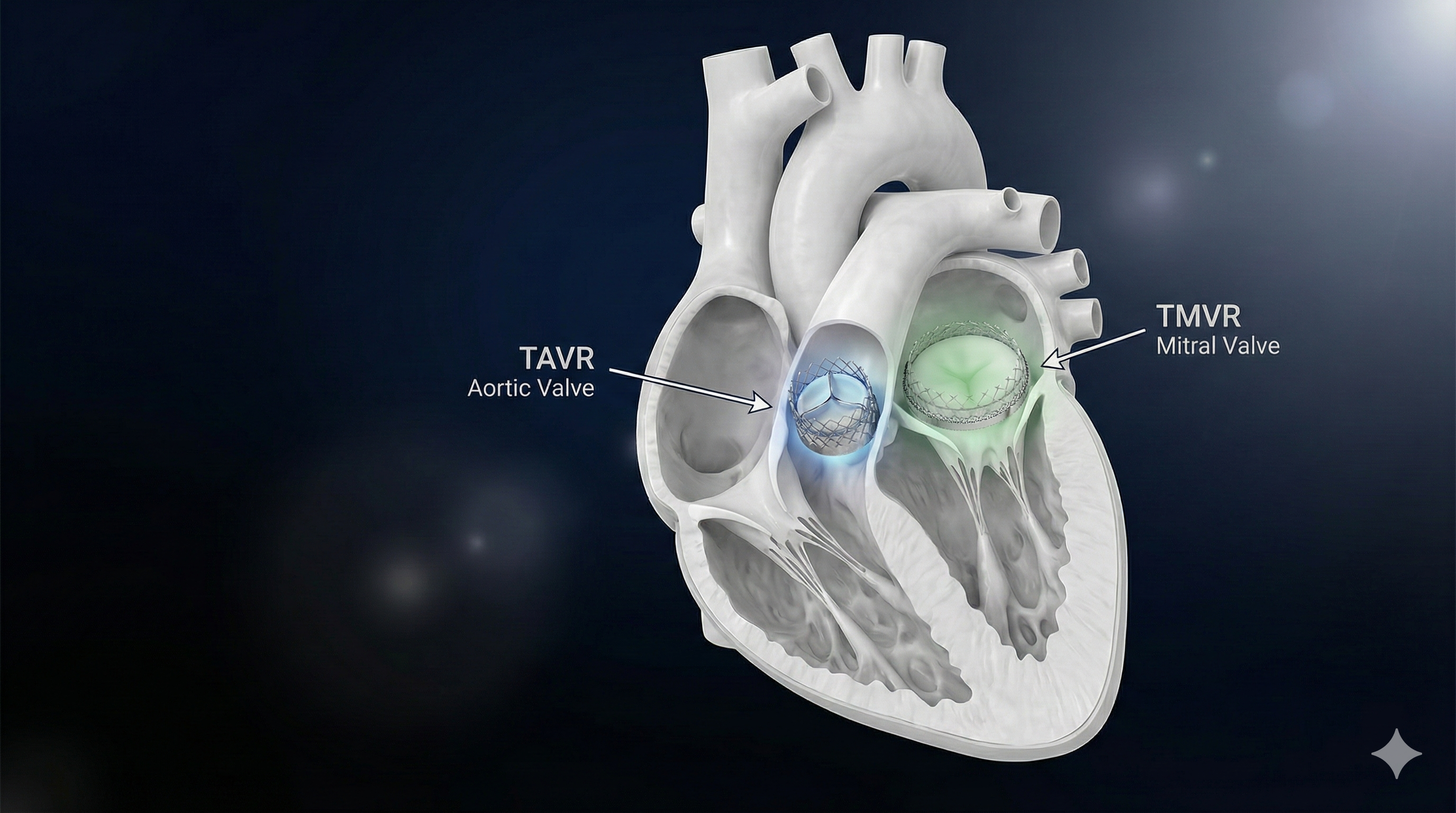
Heart valve disease has traditionally meant open-heart surgery, long recovery, and significant surgical risk—especially for elderly or medically fragile patients. Today, advances in interventional cardiology are rewriting that narrative.
One of the most remarkable developments is the ability to treat two diseased heart valves at the same time—without open surgery. This is known as simultaneous Transcatheter Aortic Valve Replacement (TAVR) and Transcatheter Mitral Valve Replacement (TMVR), also called Double Valve-in-Valve Replacement.
This advanced, minimally invasive procedure has now been successfully performed in Hyderabad, offering new hope to patients once considered inoperable or extremely high-risk.
Understanding Heart Valve Disease: Why Two Valves Can Fail Together
The human heart has four valves, but the aortic and mitral valves play the most critical roles in forward blood flow.
-
Aortic valve disease restricts blood flow from the heart to the body.
-
Mitral valve disease causes blood to leak backward into the lungs.
In many elderly patients—or in those who had previous surgical valve replacements—both valves may deteriorate over time. When both valves fail simultaneously, symptoms can be severe:
-
Breathlessness even at rest
-
Recurrent heart failure admissions
-
Fatigue and reduced quality of life
-
High surgical risk due to age or comorbidities
Traditionally, treating both valves required repeat open-heart surgery, which is often unsafe or not possible.
What Is TAVR & TMVR (Double Valve-in-Valve Replacement)?
TAVR (Transcatheter Aortic Valve Replacement) and TMVR (Transcatheter Mitral Valve Replacement) are catheter-based procedures performed without opening the chest.
In Valve-in-Valve procedures, a new transcatheter valve is placed inside a previously implanted surgical valve that has failed.
Double Valve-in-Valve Replacement means:
✔ Both aortic and mitral valves are treated
✔ In the same procedure
✔ Using catheters via blood vessels
✔ Without open surgery or heart-lung machine
This is among the most complex procedures in structural heart intervention, requiring exceptional expertise, planning, and imaging precision.
Why Simultaneous TAVR & TMVR Is Considered Rare and Complex
Performing either TAVR or TMVR alone requires a high-level heart team. Doing both together increases complexity significantly:
-
Two valves, two hemodynamic systems
-
Risk of valve interaction
-
Need for precise sizing and positioning
-
Advanced imaging guidance (CT, echo, fluoroscopy)
-
Careful sequencing during deployment
Only select centers in India with experienced structural heart programs can safely perform this procedure.
A Major Milestone in Hyderabad’s Advanced Cardiac Care
The successful performance of simultaneous non-surgical aortic and mitral valve replacement in Hyderabad reflects the city’s growing role as a center of excellence for advanced heart care.
For patients across Hyderabad, Hitec City, Telangana, and South India, this means:
-
Access to world-class valve therapy closer to home
-
Reduced need to travel abroad
-
Faster recovery with lower risk
Who Is Eligible for Double Valve-in-Valve Replacement?
This procedure is not for everyone. It is typically considered for patients who:
-
Have failed previous surgical aortic and mitral valves
-
Are high-risk or inoperable for repeat open surgery
-
Are elderly or have multiple medical conditions
-
Have suitable valve anatomy confirmed on CT scan
-
Have recurrent heart failure despite optimal medical therapy
Each patient is evaluated by a multidisciplinary Heart Team, including interventional cardiologists, cardiac surgeons, anesthetists, and imaging specialists.
Step-by-Step: How the Procedure Is Performed
1. Advanced Pre-Procedure Planning
-
Cardiac CT scan for valve sizing
-
3D echocardiography
-
Assessment of vascular access routes
2. Catheter-Based Valve Deployment
-
TAVR valve placed in the aortic position
-
TMVR valve positioned in the mitral position
-
Both procedures done through small punctures, usually via the femoral artery/vein
3. Real-Time Imaging Guidance
-
Continuous echo and fluoroscopy
-
Immediate assessment of valve function
4. Rapid Recovery
-
No chest opening
-
Short ICU stay
-
Faster mobilization compared to surgery
Benefits of Simultaneous TAVR & TMVR
✔ Avoids repeat open-heart surgery
✔ Lower procedural risk in high-risk patients
✔ Shorter hospital stay
✔ Faster recovery and rehabilitation
✔ Improved symptoms and quality of life
✔ Single combined procedure instead of two separate interventions
Life After Double Valve-in-Valve Replacement
Most patients experience:
-
Significant improvement in breathlessness
-
Better exercise tolerance
-
Reduced hospital admissions
-
Improved day-to-day activity levels
Patients typically resume normal activities much sooner than after traditional surgery, with ongoing follow-up and medications as advised.
Expert Leadership Behind Advanced Valve Care in Hyderabad
Dr. V. Rajasekhar
Senior Consultant – Interventional Cardiology & Electrophysiology
Yashoda Hospitals, Hitec City, Hyderabad
Dr. V. Rajasekhar is widely recognized for his expertise in complex coronary interventions, electrophysiology, and advanced structural heart procedures, including TAVR and transcatheter valve therapies.
His leadership and team-based approach have contributed to successful outcomes in high-risk and complex cardiac cases, bringing cutting-edge, minimally invasive heart care to Hyderabad.
Yashoda Hospitals – Hitec City
A leading center for:
-
Structural heart interventions
-
TAVR & advanced valve therapies
-
High-risk cardiac procedures
-
Multidisciplinary heart team approach
Why This Procedure Matters for Patients in Hyderabad
Hyderabad is rapidly emerging as a destination for advanced cardiac interventions. The availability of procedures like simultaneous TAVR & TMVR means patients no longer need to compromise due to age or surgical risk.
It represents a shift from “what is possible” to “what is achievable with precision medicine.”
Frequently Asked Questions (FAQs)
1. Is simultaneous TAVR & TMVR safe?
Yes, in carefully selected patients and when performed by an experienced heart team, it is a safe and effective alternative to open surgery.
2. How long does the procedure take?
The procedure typically takes a few hours, depending on complexity and patient anatomy.
3. How long is the hospital stay?
Most patients are discharged within 3–5 days, significantly shorter than surgical valve replacement.
4. Is this procedure painful?
No. It is performed under anesthesia, and recovery discomfort is minimal compared to open-heart surgery.
5. Who should not undergo this procedure?
Patients with unsuitable valve anatomy or low surgical risk may be better treated with other approaches. Evaluation is individualized.
6. How long do transcatheter valves last?
Current data suggests excellent durability, especially in elderly patients, with ongoing follow-up.
7. Can both valves really be treated at the same time?
Yes. In select cases, both valves can be replaced safely in one session, avoiding multiple procedures.
8. Is this available in Hyderabad?
Yes. Advanced centers like Yashoda Hospitals, Hitec City now offer this complex intervention.
A New Era of Minimally Invasive Heart Valve Treatment
Simultaneous TAVR & TMVR (Double Valve-in-Valve Replacement) represents the frontier of modern cardiology—where technology, expertise, and patient-centered care come together.
For patients in Hyderabad and Telangana, this innovation offers renewed hope, safer treatment options, and better quality of life, even in the most complex heart valve conditions.