 090003 25483
 Yashoda Hospitals Hitec City Hyderabad, Kothaguda, Telangana 500084

The angiogram shows three blocked arteries. What happens now?
A heart attack is already frightening. Hearing that not one, but several coronary arteries are narrowed or blocked can make the situation feel even more alarming. Families often ask the same understandable question: If the blockages are visible, why not place stents in all of them immediately?
The answer is not that the other blockages are being ignored. The first goal is to identify the artery that has suddenly closed or become critically unstable, restore blood flow quickly, and protect the greatest possible amount of heart muscle. The remaining disease must also be addressed, but the safest timing and method depend on the patient’s stability, kidney function, bleeding risk, anatomy, and whether angioplasty or bypass surgery is the better long-term strategy.
In other words, the emergency procedure and the complete treatment plan are connected – but they are not always identical.
First, understand the ‘culprit’ artery
Most heart attacks begin when a cholesterol-rich plaque inside a coronary artery ruptures or erodes. A blood clot forms over it, suddenly reducing or stopping blood flow. The artery responsible for the current heart attack is called the culprit artery or infarct-related artery.
Other narrowed arteries may be important, but they may not be causing the immediate emergency. Cardiologists identify the culprit using the patient’s symptoms, ECG pattern, angiogram, blood-flow appearance, heart-wall motion on echocardiography, and sometimes intravascular imaging.

One acute clot can trigger the heart attack, while other arteries may contain significant but more stable plaque. Each lesion may require a different decision.
The first mission: save threatened heart muscle
During an acute heart attack, time matters because heart muscle supplied by the blocked artery is starved of oxygen. Emergency angioplasty – also called primary PCI – is performed to reopen that artery. A guidewire is passed across the blockage, a balloon may be used, and a stent is commonly placed to keep the artery open.
This culprit-first approach concentrates the team’s attention on the problem most likely to cause immediate heart damage, dangerous rhythm disturbances, heart failure, shock, or death.
|
Key message: Treating the culprit first does not mean treating only one artery forever. It means handling the life-threatening problem first, then completing revascularization in the safest and most appropriate way. |
Can every important artery be treated in the same sitting? Sometimes, yes.
For a stable patient whose culprit artery has been opened successfully, current evidence supports complete revascularization – addressing other important blockages rather than routinely leaving them untreated. In selected patients, the cardiologist may safely treat suitable non-culprit blockages during the same procedure.
A same-sitting approach may be reasonable when the patient is stable, kidney function is satisfactory, the remaining lesions are clearly significant, the anatomy is straightforward, contrast exposure is acceptable, and the first part of the procedure has been uncomplicated.
However, ‘possible’ does not always mean ‘best.’ The decision should be individualized rather than driven by the number of visible narrowings alone.
Why treatment may be staged instead
Staged PCI means the culprit artery is treated during the emergency procedure and one or more remaining arteries are treated in a separate planned procedure – sometimes during the same hospital admission and sometimes after discharge within a clinically appropriate interval.
A staged approach may be selected for several reasons:
- The patient needs time to stabilize. Low blood pressure, heart failure, rhythm problems, breathing difficulty, or cardiogenic shock can make a prolonged multivessel procedure unsafe.
- The procedure is already long or demanding. Complex anatomy, heavy calcification, tortuous vessels, branch-point disease, or an unexpectedly difficult culprit lesion may increase procedure time, radiation, contrast use, and complications.
- Kidney protection matters. Angiography and PCI require iodinated contrast. In a patient with chronic kidney disease, dehydration, diabetes, or acute kidney injury, limiting the contrast used in one sitting may reduce additional strain.
- The severity of another narrowing is uncertain. An angiogram is a two-dimensional picture. A lesion that looks severe may not reduce blood flow enough to benefit from a stent, while a less dramatic-looking lesion may be important. Further assessment can prevent unnecessary treatment.
- A better technical plan is needed. Some lesions benefit from intravascular ultrasound, optical coherence tomography, calcium modification, rotablation, laser angioplasty, specialized bifurcation techniques, or circulatory support. Planning allows the correct equipment and team to be ready.
- Bypass surgery may offer a better overall result. Patients with left-main disease, complex three-vessel disease, diabetes, reduced heart function, or anatomy poorly suited to multiple stents may need a Heart Team discussion before proceeding.
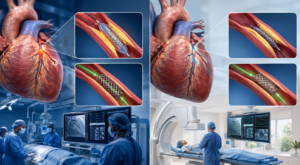
Staging separates emergency rescue from the planned completion procedure, allowing the patient and the anatomy to be reassessed between steps.
The important exception: heart attack with cardiogenic shock
Cardiogenic shock means the heart cannot pump enough blood to support the body’s organs. In this high-risk setting, routine treatment of additional non-culprit arteries during the emergency PCI is generally avoided. The priority is emergency revascularization of the culprit vessel, circulatory stabilization, and a careful plan for any remaining disease.
This is one reason families should not compare two heart-attack cases based only on the number of blockages. A strategy that is suitable for a stable patient may be harmful in a patient who is in shock.
How the cardiologist decides which blockages truly need treatment
A percentage written on an angiogram report is only one part of the decision. The cardiologist may combine several forms of information:
- Angiography: shows the location, length, vessel size, blood flow, branch involvement, calcification, and overall pattern of disease.
- FFR or iFR: pressure-wire measurements can help determine whether an intermediate narrowing is actually restricting blood flow.
- IVUS or OCT: intravascular imaging looks from inside the artery, helping define plaque, calcium, vessel size, lesion length, and optimal stent expansion.
- Echocardiography: shows pumping strength, regional wall motion, valve function, and complications of the heart attack.
- Clinical factors: symptoms, ECG, heart-attack type, kidney function, diabetes, bleeding risk, frailty, prior bypass surgery, and other illnesses all influence the plan.
For complex disease, a Heart Team – usually involving an interventional cardiologist, cardiac surgeon, imaging specialists, and the treating team – may compare PCI, bypass surgery, and medical therapy before recommending the next step.
What a staged treatment journey may look like
- Emergency diagnosis and angiography. The team confirms the heart attack, identifies the culprit artery, and assesses the full coronary anatomy.
- Culprit-vessel PCI. Blood flow is restored to the artery responsible for the acute event.
- Stabilization and reassessment. The team monitors symptoms, ECG, rhythm, heart function, kidney function, bleeding, and response to medication.
- Planning the remaining revascularization. The cardiologist decides whether another PCI, further imaging or physiology testing, bypass surgery, or medication is appropriate.
- Completion and long-term prevention. Remaining significant disease is treated when indicated, followed by cardiac rehabilitation and aggressive risk-factor control.
What happens between the first and second procedures?
A staged plan is not a period of inactivity. The patient is treated with guideline-directed medicines, usually including antiplatelet therapy, intensive cholesterol lowering, and other drugs chosen according to blood pressure, heart function, rhythm, diabetes, kidney function, and bleeding risk.
The treating team will also determine whether the next procedure should occur during the same admission or after recovery. The interval is individualized. It should be clear to the patient which artery has been treated, what remains, when follow-up will occur, and what warning symptoms require urgent care.
|
Do not stop heart medicines on your own: Stopping antiplatelet medication after a stent can allow a clot to form inside the stent. Any change – including before dental work or surgery – must be discussed with the treating cardiologist. |
Why stents are only one part of recovery
Angioplasty treats selected narrowed segments; it does not remove the tendency to develop atherosclerosis throughout the coronary circulation. Long-term recovery therefore depends on both revascularization and prevention.
- Take prescribed antiplatelet, cholesterol, blood-pressure, diabetes, and heart-protection medicines consistently.
- Attend cardiac rehabilitation when recommended and return to activity gradually.
- Stop smoking and avoid tobacco exposure.
- Adopt a heart-healthy eating pattern and work toward a sustainable weight.
- Control LDL cholesterol, blood pressure, and blood glucose to individualized targets.
- Keep scheduled follow-up and report recurrent chest discomfort, breathlessness, fainting, palpitations, or unexplained fatigue.
Questions patients and families often ask
1. Is it dangerous to leave another blockage untreated for a few days or weeks?
A staged plan is chosen only after weighing the short-term risk of the remaining lesion against the risk of extending the emergency procedure. The patient is monitored and treated medically in the interval. Ask the team whether the second procedure is planned during the same admission or after discharge.
2. Does every 70% or 80% blockage need a stent?
No. The percentage is an estimate and must be interpreted with symptoms, vessel size, lesion location, blood-flow testing, imaging, heart function, and the overall pattern of disease. Some lesions are treated with PCI, some with bypass surgery, and some with medication.
3. Will one blockage always require one stent?
Not necessarily. A long lesion may require more than one stent, while some lesions may be treated with a single stent or no stent. The aim is not to maximize the number of stents; it is to achieve a durable, safe result.
4. When is the second angioplasty usually performed?
Timing varies. It may be performed during the same hospital stay or at a planned later date, depending on stability, kidney function, anatomy, symptoms, and local clinical protocols.
5. Can bypass surgery be better than multiple stents?
Yes. CABG may provide a better long-term strategy for some patients with complex three-vessel disease, left-main disease, diabetes, reduced heart function, or anatomy unsuitable for PCI. A Heart Team discussion is especially valuable in these cases.
6. What if kidney function is reduced?
The team may reduce contrast volume, optimize hydration when appropriate, review medicines, monitor kidney tests, use imaging-guided low-contrast techniques, or stage procedures to limit renal stress.
7. Can all arteries be treated in one procedure safely?
In selected stable patients with suitable anatomy, yes. Current guidance supports complete revascularization and allows significant non-culprit lesions to be treated either immediately or in a staged procedure. The best timing is individualized.
8. Can I go home before the remaining blockage is treated?
Some patients can; others should remain in hospital. Discharge depends on symptoms, heart function, rhythm, kidney function, procedure result, mobility, home support, and the urgency of the remaining treatment.
9. Which symptoms after discharge need urgent attention?
New or worsening chest pressure, severe breathlessness, fainting, cold sweating, sudden weakness, sustained palpitations, or pain similar to the original heart attack require urgent medical evaluation.
10. Can another heart attack still occur after successful PCI?
Yes, although treatment and prevention reduce risk. Atherosclerosis can affect multiple parts of the coronary circulation. Medicines, cardiac rehabilitation, risk-factor control, and follow-up remain essential even when every planned procedure has been completed.
11. When should I consult a cardiologist after a staged angioplasty plan?
Follow the review date given at discharge. Seek earlier advice if chest discomfort returns, breathlessness worsens, medicines cause concerning side effects, or the timing of the next procedure is unclear. New severe or persistent symptoms require emergency care rather than a routine clinic visit.
12. Where can I consult Dr. Rajasekhar Varada?
Dr. Rajasekhar consults at Yashoda Hospitals, Hitec City, Hyderabad. Both in-person OPD appointments and online video consultations are available through the hospital’s appointment system. Current timings should be confirmed before travelling.
The question to ask is not ‘Why didn’t they stent everything?’
A better question is: What is the safest complete revascularization plan for this patient?
For one person, that may mean treating suitable arteries during the same procedure. For another, it may mean culprit-first PCI followed by staged angioplasty. For someone with complex disease, bypass surgery may offer the best result. The number of arteries involved is important, but it is only one part of the decision.
A thoughtful plan protects heart muscle during the emergency while also looking beyond the first 24 hours toward kidney safety, procedural success, future heart-attack risk, symptom relief, and long-term quality of life.
About Dr. Rajasekhar Varada
Dr. Rajasekhar Varada is a senior interventional cardiologist and Clinical Director in Hyderabad with 27 years of clinical experience. He is known for expertise across both interventional cardiology and electrophysiology.
He performs approximately 700 angioplasties annually, about 300 electrophysiology procedures, and more than 100 cardiac device implantations, including resynchronization devices, defibrillators, and leadless pacemakers.
His areas of expertise include complex and high-risk PCI, image-guided PCI, rotablation, laser coronary angioplasty, TAVR, TMVR, and Impella-assisted PCI. He is a certified TAVR operator and proctor, a proctor for image-guided PCI and rotablation, and a proctor for cardiac device implantation, including leadless pacemaker procedures.
Consultation locations
In-person consultation – Yashoda Hospitals, Hitec City
Dr. Rajasekhar Varada consults in the Cardiology and Interventional Cardiology department at Yashoda Hospitals, Hitec City, Kothaguda, Hyderabad, Telangana 500084.
Day-time OPD schedule: Monday to Friday, 9:00 AM to 5:00 PM; Saturday, 9:00 AM to 1:00 PM. Timings may change because of emergency procedures or hospital schedules, so patients should confirm their appointment before travelling.
Appointments and updated schedule: View Dr. V. Rajasekhar’s official Yashoda Hospitals profile
Online video consultation
Patients who cannot travel to Hyderabad may request an online video consultation through the same Yashoda Hospitals profile. For a useful review, keep recent ECGs, echocardiograms, angiogram reports or images, discharge summaries, kidney-function tests, and a current medicine list ready.
|
Emergency reminder: An online or routine OPD consultation is not appropriate for ongoing chest pressure, severe breathlessness, fainting, cold sweating, or other possible heart-attack symptoms. Call emergency medical services immediately. |
|
Patient-care note: A treatment recommendation must be based on the patient’s ECG, angiogram, heart function, symptoms, kidney function, bleeding risk, and complete medical history. This article is educational and does not replace individualized medical advice. |