 090003 25483
 Yashoda Hospitals Hitec City Hyderabad, Kothaguda, Telangana 500084
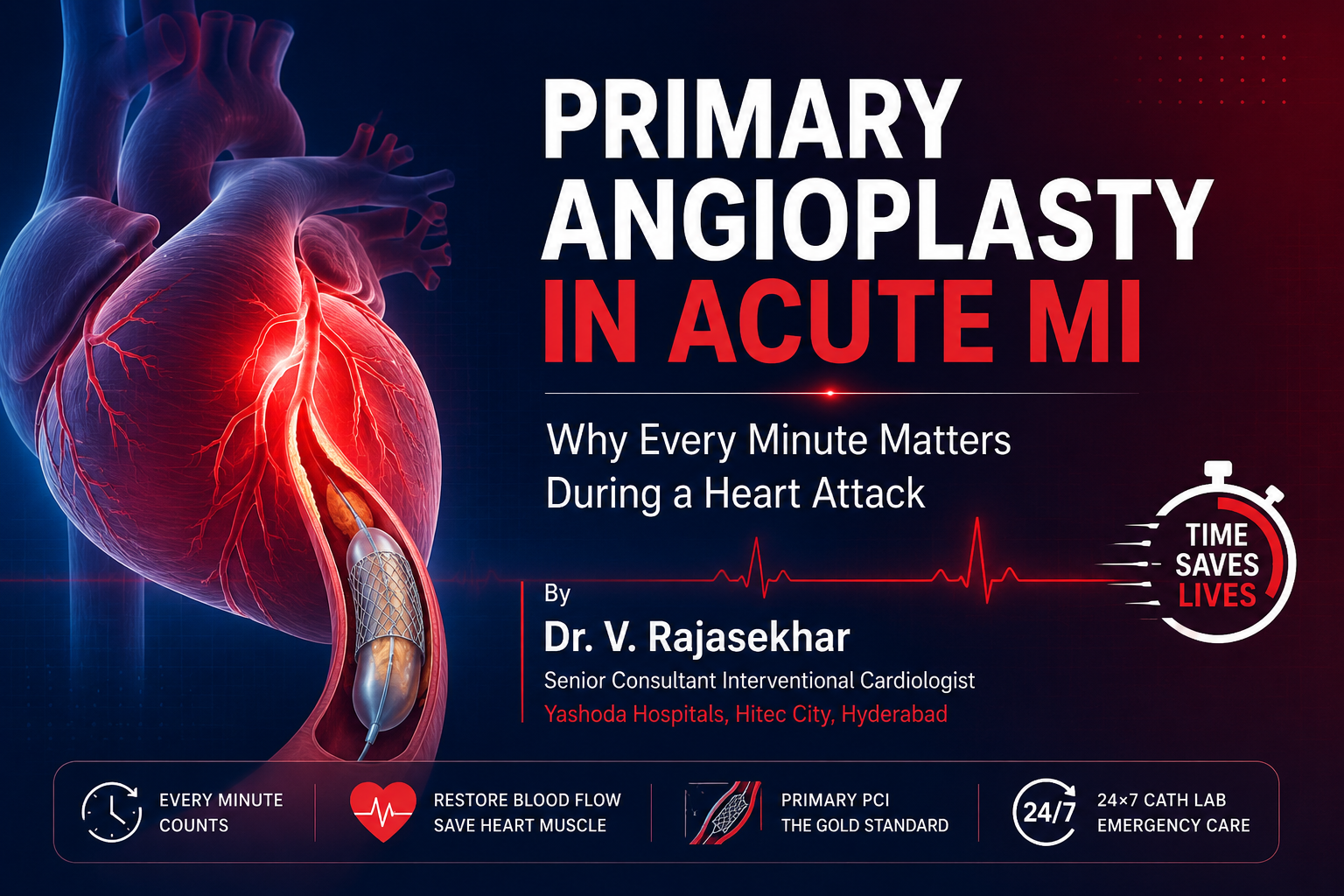
How Timely Primary PCI Saves Heart Muscle, Preserves Life, and Prevents Long-Term Heart Failure
By Dr. V. Rajasekhar
Senior Consultant Interventional Cardiologist
Yashoda Hospitals, Hitec City, Hyderabad
“It’s Just Gas…” – The Most Dangerous Assumption During a Heart Attack
At 5:30 AM, a 54-year-old businessman woke up with a heavy pressure in the center of his chest. Assuming it was acidity from the previous night’s dinner, he took an antacid and went back to bed.
Thirty minutes later, the pain became unbearable. It spread to his left arm, he broke into a cold sweat, and started feeling nauseous.
His family rushed him to the emergency department.
Within minutes, an ECG confirmed one of the most dangerous cardiac emergencies—a ST-Elevation Myocardial Infarction (STEMI), commonly known as a major heart attack.
Fortunately, he reached a hospital equipped with a 24×7 cardiac catheterization laboratory. Within 45 minutes, the blocked artery was opened using Primary Angioplasty (Primary PCI).
Today, he leads a completely normal life with preserved heart function.
Had treatment been delayed by just a few hours, the outcome could have been drastically different.
This is why cardiologists repeatedly emphasize one simple truth:
Every minute counts during a heart attack.
Understanding a Heart Attack
A heart attack occurs when one of the arteries supplying blood to the heart becomes suddenly blocked.
Most commonly, this blockage happens because a cholesterol plaque inside the artery ruptures.
Once the plaque breaks open:
- Platelets immediately gather
- A blood clot forms rapidly
- Blood flow stops completely
- The heart muscle begins dying
Unlike many other organs, the heart has almost no backup blood supply.
Without oxygen, heart muscle cells begin to die within minutes.
The longer the artery remains blocked, the larger the permanent damage.
Why Cardiologists Say “Time is Muscle”
One of the most famous phrases in cardiology is:
Time is Muscle.
This is not just a slogan.
Every passing minute means more heart muscle is permanently lost.
Approximately:
- Within 20–30 minutes, irreversible muscle injury begins.
- Within 2 hours, a significant portion of the heart may already be damaged.
- By 6 hours, much of the affected muscle may become permanently dead.
- After 12 hours, opportunities to salvage the heart decrease dramatically.
Every delay reduces survival and increases complications.
What is Primary Angioplasty?
Primary Angioplasty, also called Primary Percutaneous Coronary Intervention (Primary PCI), is the gold standard treatment for acute STEMI.
Instead of dissolving the clot using medications, cardiologists immediately open the blocked artery mechanically.
The goal is simple:
Restore blood flow before permanent damage occurs.
Primary angioplasty offers:
- Immediate restoration of circulation
- Less heart muscle damage
- Better survival
- Lower risk of heart failure
- Reduced chances of another heart attack
How Primary Angioplasty is Performed
Step 1: Immediate Diagnosis
As soon as the patient arrives:
- ECG confirms STEMI
- Blood tests begin
- Cardiology team is activated immediately
No unnecessary delays occur.
Step 2: Emergency Cath Lab Transfer
The patient is shifted directly to the cardiac catheterization laboratory.
Time is extremely valuable.
Every hospital aims for a Door-to-Balloon Time of less than 90 minutes.
Step 3: Coronary Angiography
A small catheter is inserted through the wrist (radial artery) or groin.
Contrast dye identifies:
- Which artery is blocked
- Severity of blockage
- Blood flow
- Additional narrowed arteries
Step 4: Balloon Angioplasty
A tiny balloon is guided across the blockage.
The balloon inflates briefly to reopen the artery.
Step 5: Stent Placement
A drug-eluting stent is implanted.
The stent acts as a permanent scaffold keeping the artery open.
Blood flow is restored immediately.
The patient often experiences dramatic relief of chest pain within minutes.
Why Primary PCI is Better Than Clot-Busting Medicines
Years ago, thrombolytic injections were the standard treatment.
While these medications can dissolve clots, they have several limitations.
Primary angioplasty provides:
✔ Higher success rates
✔ Faster restoration of blood flow
✔ Lower mortality
✔ Less bleeding risk
✔ Reduced stroke risk
✔ Better long-term outcomes
Whenever available, Primary PCI is the preferred treatment worldwide.
Symptoms You Should Never Ignore
Heart attack symptoms can vary.
The classic warning signs include:
Chest Symptoms
- Heavy pressure
- Tightness
- Crushing pain
- Burning sensation
Pain Spreading To
- Left arm
- Right arm
- Jaw
- Neck
- Shoulder
- Back
Other Warning Signs
- Cold sweating
- Breathlessness
- Nausea
- Vomiting
- Extreme weakness
- Sudden dizziness
- Fainting
Some patients, especially diabetics and elderly individuals, may experience only:
- Breathlessness
- Fatigue
- Sweating
- Mild discomfort
These are called silent or atypical heart attacks.
Who is at High Risk?
Several factors increase the risk of heart attack.
Major Risk Factors
- Diabetes
- High blood pressure
- High cholesterol
- Smoking
- Obesity
- Sedentary lifestyle
- Family history
- Chronic kidney disease
- Stress
- Poor sleep
Patients with multiple risk factors should never ignore chest pain.
The Golden Hour
The first 60 minutes after symptoms begin is known as the Golden Hour.
Treatment during this period offers:
- Maximum heart muscle salvage
- Better heart pumping function
- Lower mortality
- Faster recovery
Patients treated within the first hour often return to normal life with minimal permanent damage.
What Happens if Treatment is Delayed?
Delaying medical care can result in devastating complications.
These include:
Severe Heart Failure
Large portions of heart muscle become permanently damaged.
Dangerous Arrhythmias
Electrical instability may cause:
- Ventricular Tachycardia
- Ventricular Fibrillation
- Sudden Cardiac Death
Cardiogenic Shock
The weakened heart cannot pump enough blood to vital organs.
Mortality becomes extremely high.
Mechanical Complications
Delayed treatment may lead to:
- Valve rupture
- Septal rupture
- Free wall rupture
These often require emergency surgery.
Recovery After Primary Angioplasty
Most patients begin recovering remarkably quickly.
Hospital stay is usually:
- 2–4 days
Recovery includes:
- Cardiac rehabilitation
- Lifestyle modification
- Medications
- Risk factor control
Most individuals gradually return to work and normal activities within a few weeks, depending on the severity of heart damage.
Modern Technologies That Improve Outcomes
Today’s primary angioplasty is far more advanced than it was a decade ago.
At Yashoda Hospitals, advanced technologies may include:
- IVUS (Intravascular Ultrasound)
- OCT (Optical Coherence Tomography)
- FFR assessment
- Mechanical circulatory support in high-risk cases
- Advanced drug-eluting stents
- Radial artery access for faster recovery
These technologies improve precision and long-term success.
How to Reduce Your Risk of a Heart Attack
While not every heart attack can be prevented, your risk can be significantly reduced by:
- Quitting smoking
- Controlling diabetes
- Maintaining healthy blood pressure
- Lowering cholesterol
- Exercising regularly
- Eating a heart-healthy diet
- Maintaining healthy weight
- Managing stress
- Getting regular heart check-ups
Prevention remains the best treatment.
Why Choose Dr. V. Rajasekhar?
Dr. V. Rajasekhar is a highly experienced Senior Consultant Interventional Cardiologist at Yashoda Hospitals, Hitec City, Hyderabad, with expertise in:
- Primary Angioplasty (Primary PCI)
- Complex Coronary Interventions
- Left Main Angioplasty
- Bifurcation PCI
- CTO Interventions
- IVUS & OCT Guided Angioplasty
- Rotablation and Intravascular Lithotripsy
- High-Risk Coronary Procedures
Using evidence-based treatment and advanced interventional technologies, Dr. Rajasekhar is committed to delivering rapid, precise, and life-saving cardiac care when every second matters.
A heart attack is one of the few medical emergencies where every single minute directly affects survival.
The difference between a full recovery and lifelong heart failure often comes down to how quickly the blocked artery is reopened.
Primary angioplasty has transformed heart attack care, allowing patients to survive, recover faster, and return to active lives.
If you or someone around you develops sudden chest pain, breathlessness, cold sweating, or pain radiating to the arm or jaw, do not wait. Do not self-medicate. Call emergency medical services immediately and reach a hospital capable of performing Primary PCI.
Remember: Time is Muscle. Every Minute Saves Heart Muscle. Every Minute Saves Lives.