 090003 25483
 Yashoda Hospitals Hitec City Hyderabad, Kothaguda, Telangana 500084

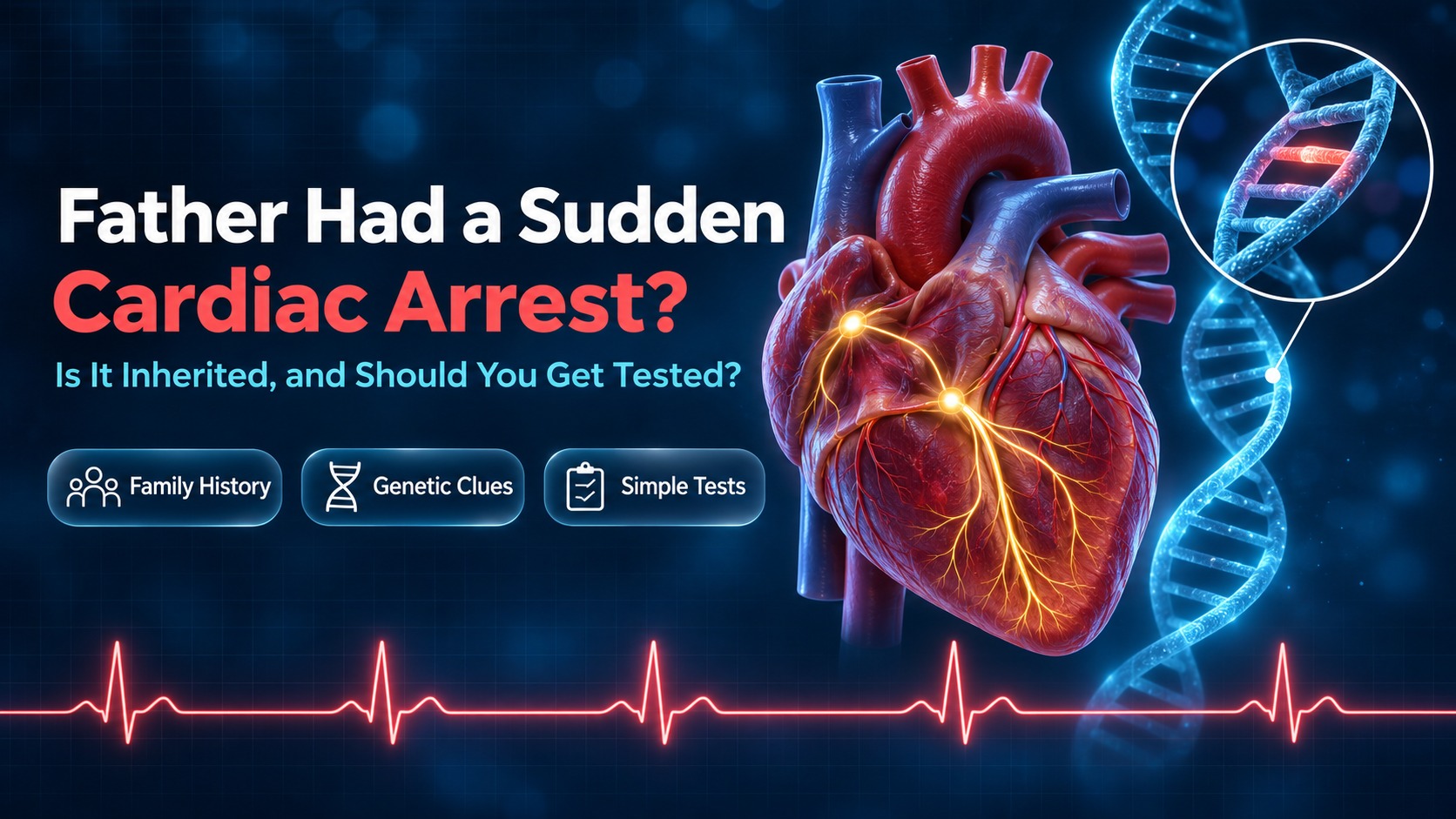
“My father died suddenly of a cardiac arrest. Could the same thing happen to me, or to my children?”
MD, DM (Cardiology) · Interventional Cardiologist & Electrophysiologist✔ Medically reviewed⏱ 8 min read
Two Very Different Stories Behind a Sudden Death
Story A: Older age, known heart disease
A father in his 60s or 70s with diabetes, smoking or known blockages has a cardiac arrest during a heart attack. Children share some risk through genes and lifestyle, but much of it is modifiable: cholesterol, BP, sugar, tobacco and weight.
Story B: Young, unexplained, out of the blue
A father, sibling or cousin under about 50, apparently healthy, collapses suddenly, perhaps during exercise, sleep or swimming. Here an inherited electrical or heart muscle condition must be considered, and close relatives should be screened.
“When a family comes to me after a sudden death, my first questions are simple: how old was he, what was he doing, and was a cause ever found? Those three answers guide everything that follows.”
Clues That Point to an Inherited Condition
📝 Does your family history include any of these?
Which Conditions Run in Families?
Cardiomyopathies
Hypertrophic (thick muscle), dilated (enlarged, weak heart) and arrhythmogenic cardiomyopathy. Often detected on an echo or cardiac MRI.
Long QT syndrome
An electrical condition that can cause sudden fainting or arrhythmia, sometimes triggered by exercise, emotion or certain medicines. Often visible on an ECG.
Brugada syndrome
Can cause dangerous rhythms, often at rest or during sleep, and may be unmasked by fever. Sometimes needs a special drug challenge test.
CPVT
Causes dangerous rhythms during exercise or emotional stress, even with a normal resting ECG.
Familial hypercholesterolaemia
Inherited very high LDL cholesterol leading to heart attacks at a young age. Easily detected with a blood test and very treatable.
Step-by-Step: What the Family Should Do Now
Gather the facts
Age at the event, what he was doing, any previous fainting or symptoms, and any ECGs, echo reports, hospital records or post-mortem findings.
If he survived, get him fully evaluated
A survivor of cardiac arrest needs a detailed workup to find the cause. This also guides testing for the rest of the family.
Screen first-degree relatives
Children, brothers and sisters, and parents should be checked, usually starting with an ECG and echo.
Consider genetic testing
Testing works best when it starts with the affected person, or their stored sample. If a gene variant is found, relatives can be tested for that specific change.
Repeat screening over time
Some conditions appear only in the teens or adulthood, so children and young adults may need periodic re-checks even if the first tests are normal.
Tests for Relatives
| Test | Why it’s done | Who usually needs it |
|---|---|---|
| 12-lead ECG | Detects long QT, Brugada pattern, WPW and clues of cardiomyopathy | All first-degree relatives |
| Echocardiogram | Checks heart muscle thickness, size and pumping | All first-degree relatives |
| Exercise (treadmill) test | Can unmask exercise-triggered rhythm problems | Selected relatives |
| Holter / long-term monitor | Records rhythm through daily life | Those with symptoms or ECG clues |
| Cardiac MRI | Detailed view of muscle and scarring | When the echo is unclear or a cardiomyopathy is suspected |
| Drug challenge test | Unmasks hidden Brugada pattern | Only when Brugada syndrome is suspected |
| Lipid profile and Lp(a) | Detects inherited cholesterol problems | Families with early heart attacks |
| Genetic testing | Identifies the exact inherited variant | Selected cases, with genetic counselling |
If a Condition Is Found: What Next?
A diagnosis can feel frightening, but it is the first step to protection. Depending on the condition, treatment may include:
Medicines
Beta-blockers and other medicines can reduce the risk of dangerous rhythms in several conditions.
Avoiding triggers
Avoiding certain medicines (for example in long QT), treating fever promptly (in Brugada) and tailored exercise advice.
ICD
An implantable cardioverter-defibrillator monitors the heart and delivers a life-saving shock if a dangerous rhythm occurs, for those at high risk.
Catheter ablation
Can cure certain rhythm problems such as WPW, and help manage others.
🚩 Seek urgent care if a family member has
- Fainting during exercise or with no warning
- Chest pain, breathlessness or a racing heart with dizziness
- A seizure-like episode with no clear neurological cause
✅ Reassuring to know
- Most relatives who are screened turn out to be normal
- Inherited conditions vary widely in severity, even within one family
- Early diagnosis allows effective prevention
- Many people with these conditions live full, active lives
Questions Families Ask
My father was 72 and had blocked arteries. Am I at high risk?
At what age should children be screened?
If my ECG and echo are normal, am I completely safe?
Is genetic testing available in India?
Should I stop exercising until I’m tested?
📌 Remember these points
- Age and circumstances of the sudden death guide your risk.
- Unexplained sudden death under about 50 is a strong reason for family screening.
- ECG and echo are simple first tests for close relatives.
- Most inherited heart conditions can be managed once diagnosed.
Lost a family member suddenly? Protect the rest of the family.
Dr. V. Rajasekhar, an electrophysiologist, evaluates families after a sudden cardiac death or cardiac arrest and plans focused screening, genetic testing and prevention.
Dr. V. Rajasekhar (Dr. Rajasekhar Varada)
As an electrophysiologist, Dr. Rajasekhar specialises in diagnosing and treating heart rhythm disorders, including inherited conditions, and in ICD and catheter ablation therapy.
This article is for general patient education and does not replace a personal medical consultation. Diagnosis and treatment depend on your individual symptoms, test results and overall health. References: ESC Guidelines for the Management of Patients with Ventricular Arrhythmias and the Prevention of Sudden Cardiac Death; HRS/EHRA/APHRS Expert Consensus on Inherited Primary Arrhythmia Syndromes; ESC Guidelines on Cardiomyopathies.